

This interview is part of the Beacon’s conversations with the candidates for state representative in the 27th Middlesex district. You can read our interview with Ben Ewen-Campen here. The transcript below has been lightly edited for length and clarity.
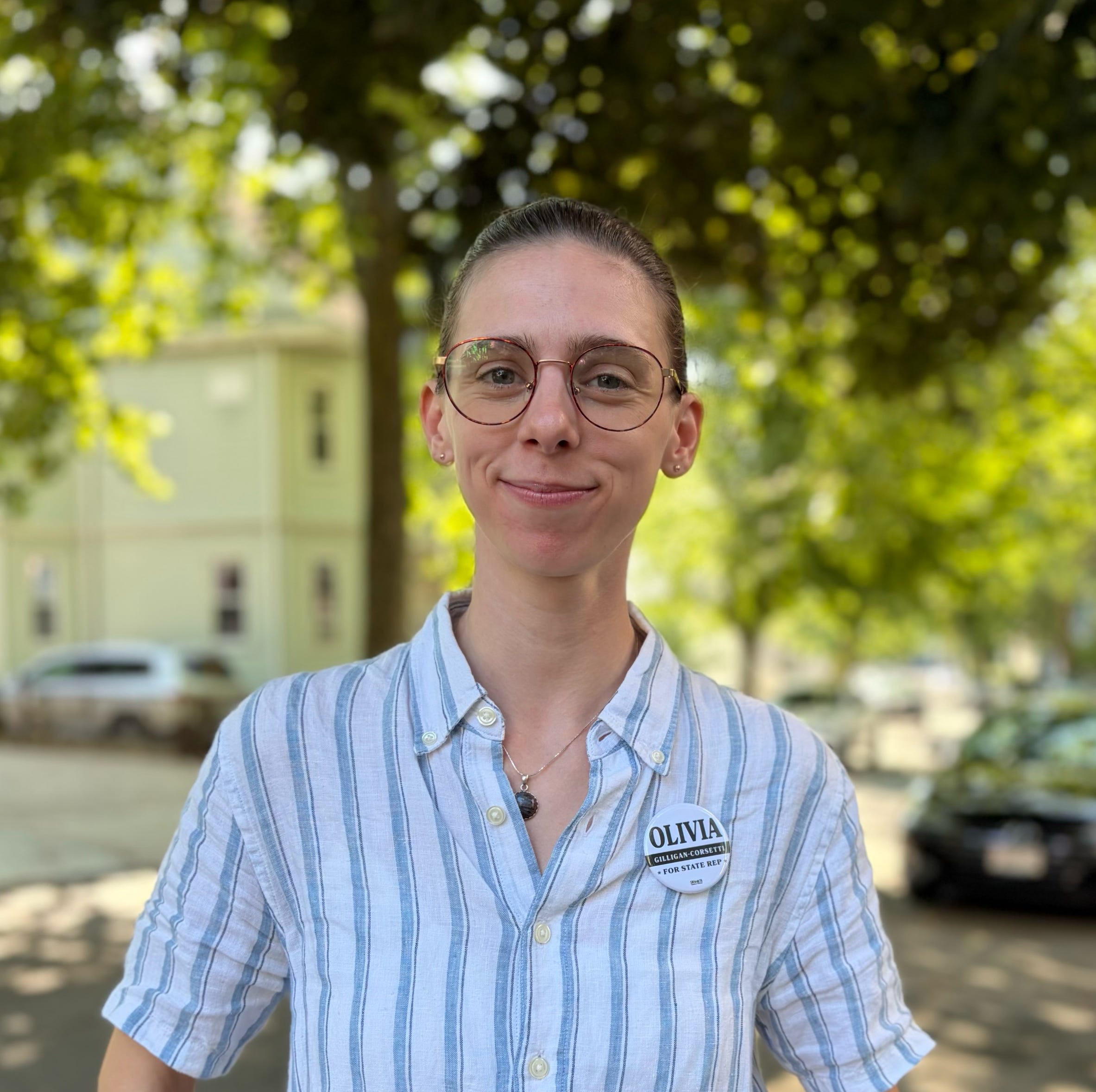
Ben: You said in your Cambridge Day interview that part of your motivation for running was not liking the idea, in a democracy, of one person just walking into an open seat. What’s the case for you specifically being a better rep than Ewen-Campen, versus just that we should have more options in the race?
Olivia: When I did that interview, it was early on in the race process. Where I’m at now, when folks ask at the door what the differences are, I first lead with my experience at the State House working for Representative Denise Provost and Governor Maura Healey. The constituent services I provided for thousands of residents, and the one-on-one assistance for working through bureaucracy and finding the specific programs that state agencies offer. I think this would be a very valuable thing for Somerville to have at the State House, especially while more cuts are going to be coming. Older folks, folks with disabilities, and those who oftentimes their voices aren’t heard, because it’s challenging to speak up when you’re also dealing with a personal crisis. I think that’ll be a benefit for us, to have a state rep who has that experience.
Ben: How do you imagine splitting your time between constituent services and getting legislation through?
Olivia: I think it’s a process that happens at the same time. As constituent issues come up, I think there’s a tracking of what are the biggest issues that we’re seeing, and the issues are often ones that legislation could be used to help. So if folks are having issues with their high utility costs, let’s see, there’s a bill that would ensure that Eversource is only fixing pipes that actually have leaks. Right now, they are incentivized to fix any pipe, and this is causing a lot of disruption on our streets, and oftentimes the roads aren’t put back in a way that is good for our cars. So there are direct correlations between legislation and the issues that are persevering in people’s lives. So just making those connections.
Ben: What do you think your biggest policy differences with Ben Ewen-Campen are?
Olivia: My experience working with caregivers and being a caregiver, I think, is one of the most important things I would bring to the job. There are so many folks who are caregiving and not being seen, and there are older folks at home, parents who are taking care of kids, and that labor is going unnoticed. And again, as federal cuts happen, it’s usually these communities that are affected the most. SNAP benefits and fuel assistance for people who have low income are going to be heavily affected. And I’ve seen it firsthand how challenging it is to navigate the system, and would love to make sure our caregivers, who are often women, our teachers, who are very often women, are protected from workplace violence and are being paid a livable wage.
Ben: How do you translate that into a bill or concrete policy change?
Olivia: In terms of having our workers work close to home or having easier transit — time is money. There’s a single mom who’s a friend of mine who now commutes two hours from Malden. And I was trying to use my connections in Somerville to see, are there any jobs? The school wasn’t hiring. And it’s really challenging for folks, especially with English being their second language, finding employment close by. So having more jobs programs that people can work in the cities that they live in. And if they’re unable to find that, being able to commute faster. One of the buses that she takes — limited service. So how can we make it easier for her to get home to her daughter and afford to live closer to work?
Ben: So legislatively, that might mean more funding for jobs programs in cities, or for the MBTA?
Olivia: Yeah. Dedicated bus lanes, and really listening to the community. I know the MBTA does do outreach and makes sure that when they’re changing routes, they’re listening to people. But are we actually getting to all the people who use that bus, and really focusing on that? Because it’s a bigger issue than I think a lot of folks recognize.
Ben: A classic challenge for someone new to the State House is that as a freshman you don’t have much power yet, so you’re limited in what you can actually get through. How do you navigate that and still be effective?
Olivia: I had the opportunity to work with legislators both at the State House in 2015 and as a restaurant server in Carrie Nation. And, you know, seeing folks as they’re looking to get food, or they’re humans going to work, I am able to connect with people on a lot of different levels. And so, talking about regional rail and making sure that we have good trains that are accessing different parts of Massachusetts, I feel comfortable that I’ll be able to work with these people. I have already worked with their staff, more so than with the reps and senators themselves, to make sure that constituents were getting the services they need. And sometimes it takes both the governor’s office and the representative’s office, and usually it’s the aides in those offices that are doing a lot of the heavy lifting. So I feel confident that I’ll be able to use my communication skills and interpersonal relationship building. Most of the jobs I’ve had have been constituent services, restaurant work, plumbing (you have to work with people also), teaching, and all these are people-person skills.
Ben: How can voters get a sense of your policy positions? Ewen-Campen has the advantage of lots of council votes where he’s gone on the record; we don’t have that for you. How do we know where you stand?
Olivia: Whatever the topic is I’d be happy to answer. I think that until we all have safe housing and access to clean, healthy water and food, we’re not doing it well. Our society is still not functioning as it should be. And I don’t think we need to attack those who are doing the legislature currently to say this is a failing system.
Ben: Where are you on housing policy?
Olivia: Yeah. So I am a renter; my mom’s a homeowner. I see us building schools and families leaving. I am concerned about being someone who wants to start a family and unsure if I can afford to purchase my first home in my hometown. There’s also a challenge of environment, and I see new developments where the foundation of the house goes right up to the sidewalk, and they’ve taken away three feet of grass or green space. And that I don’t like seeing in my town. I really want to make sure that — I’m happy to build up. I think for me personally, six to eight stories feels ideal in the more metro areas. I’m happy to build more. I just want to make sure we’re not taking away green space that is so desperately needed. We’re the most densely populated city in New England, and I want my children to be able to interact with cardinals and butterflies, and if we take away what little space we have, it just doesn’t feel right. The MBTA — the state is in charge of the community path — so making sure we’re keeping that and never losing green space here, that would be a priority.
Ben: What’s your diagnosis of Somerville’s housing market?
Olivia: It’s in bad shape. The families thing I’ll just bring up again. So many of the buildings that I saw growing up are now broken into three-family or three-apartment condos. And it’s challenging for a family who wants to have some green space and have a little more room to grow, for us to have families. So yeah, I’m concerned with making so many things small and for individuals in our city.
Ben: So you feel it’s not a great move to break up a triple decker into three condos, for example?
Olivia: Before I was born, my great-grandparents had a house. And then my grandma was born in the house. And they were able to live three generations in one house and afford to do that. It seems impossible nowadays to renovate a full family house and keep a family there. There still are obviously families in Somerville, but it’s just more challenging if you want to have two kids, live on one floor with a two-bedroom.
Ben: Is part of your assessment that Somerville is too expensive?
Olivia: Yes.
Ben: Why is that, and what can we do?
Olivia: We have been the residential location for the Greater Boston area for a very long time. And we’re 70% residential. We need to improve our commercial sector. Cambridge has a much better balance of commercial and residential, and we have, I think, 14 vacancies in Davis Square. There are vacancies in so many squares. It needs to be easier for someone to start a business and have that cash flow come in so that our taxes aren’t completely burdening the residents. That’s a huge one.
Ben: So more tax income from commercial properties would lead to less property tax for residents?
Olivia: Yes, when more of the tax base comes from commercial development, residents won’t have to fund as much of our projects through their own property taxes.
Ben: Any state-level housing policy changes you’d like to see?
Olivia: The availability for middle-income folks to get assistance. I’ve heard it a lot, but I haven’t seen what the action is so much, to make it easier for someone to live in Somerville and get assistance even if their median income is larger than what you need to get benefits. For our unhoused and folks dealing with drug addiction, I think there needs to be better programs for supportive housing in community with counselors. I mentioned this at the debate, having a better pathway for people who are struggling, so they don’t fall back into, if it’s an incarceration system, or just off the grid. Too often, it’s really hard to get the information from someone and stay up to date while they’re dealing with crisis. So more funding there, because in the long run, it’ll save us money to help these people.
Ben: Banning toxic pesticides seems to be a centerpiece of your platform, and you have a personal connection to it. Do you want to talk about that?
Olivia: So in 2016, on April Fool’s Day, we got the call that my dad was diagnosed with cancer. It was a late-stage non-Hodgkin’s lymphoma. And doctors say it was likely caused by Roundup, the pesticide. Designed by Monsanto; the company was bought by Bayer. And there are a lot of cancer cases and Parkinson’s cases tied to pesticides and herbicides. We are putting endocrine disruptors in our environment, PFAS in our water. There are a lot of chemicals we have to deal with. In my studying of engineering, I see the amazing things that you can do with plastic and concrete, but we don’t seem to, as a society, take responsibility for the fact that we’re poisoning ourselves and the environment.
So my sister moved home from Pittsburgh, I moved home from college, and my mom quit her job, and we all returned home to be caregivers. He would have cancer treatment, go to a rehab, come home, and there was a cycle there for two and a half years before he passed. So I want to make sure that no family suffers. This is a preventable disease.
I understand that we have a mass agriculture system. We have a monopoly over our food system, and it’s a very uphill battle, but Europe has a much better policy with glyphosates. They still use them, but it’s to a lesser degree, and I think working with regional partners, working with our restaurants, making sure that the food that we’re bringing in doesn’t have these poisons. And it’s a very big question to ask, of how we do this. So I hope I can help solve this issue.
Ben: Do you have thoughts on what a bill you’d support or sponsor would look like?
Olivia: There is already legislation that’s been presented. I am focusing this short campaign on meeting as many people, and I haven’t written or signed on to any other bills. I hope to use the opportunity of gaining the folks’ votes so that I can do this. I know that it’s not the top of many people’s list of issues we have to solve. I hope more people become aware, and I personally don’t want to go to the store anymore and look at the label and say, oh, if it starts with a four, I shouldn’t eat it because it has bad things. The label: if it starts with a nine, that means it’s organically grown. If it starts with a four, it’s not. I would like to go to the store and know everything I’m consuming isn’t going to cause some disease.
Ben: I’m a housing nut, so back to housing: any thoughts on the MBTA Communities Act, or the duplex proposal in the Senate right now?
Olivia: I think the MBTA Communities Act needs to be more strictly enforced. I have seen Somerville do its share. We’re building, we’re working hard to make sure that more units are coming online, and towns that aren’t participating aren’t doing their share. On the duplex question, in theory, I’m okay with this. I just want to make sure that in the municipalities, on the lots, the people who live there can have a say. And if there is some issue — I know that there’s a case with a friend of mine, and behind her house, three buildings were built in one lot. And it comes right up to her yard, and it looks like it could be destroying a tree. And again, it’s this taking away of green space. I don’t find that we have enough of it for us to be eliminating it at the rate we’re doing it. What are your takes, by the way?
Ben: What are my takes? I think housing is our biggest issue as a state. We’re losing population, and the top reason people give when they leave the state is because they can’t afford to house themselves, which I think is a pretty big deal. A shrinking state is losing revenue. It’s also losing electoral power. And to me, it’s sort of a tragedy. I have friends that need to move out of the state simply because they want to buy a house.
My take on it is that this is fairly self-inflicted, through restrictive zoning. If we could just build more housing, housing would get a lot cheaper. I’m a pretty big believer in supply and demand affecting the price there. And so things like making duplexes by right statewide, to me, seems like a great first pass. Let’s increase the density. We don’t have to go crazy with it, but start there and see what happens.
Olivia: I agree with that. And I also find that — if we could let the cities decide more. I don’t think the state should be taking away that opportunity. It should be the city.
Ben: Well right now, Somerville controls its zoning. It is lightly affected by state-level rules. The MBTA Communities Act didn’t do too much here because we were already fairly dense. And my view of the Somerville housing market is that it is constrained by supply, by zoning limiting us to two stories in most of the city. You could say “the state should make it so you can build six stories across the whole state and override all of local zoning!” That’s one option, on the more extreme side of state power. Or you could say municipalities should get to decide. If they want to be a two-story town, that’s their call. That’s their right. So where on that spectrum do you think you come down? Sounds like you’re more on the municipality side.
Olivia: I’m more on the municipality side. It’s a great question. I think six stories isn’t too drastic if we allow that, and just giving more access to the city to decide seems, yeah, the smart thing.
Ben: Okay. So you’re a local control fan, it sounds like, more than the state.
Olivia: I am.
Ben: If you’re elected, at the end of your first term what’s a good way to judge whether you’ve been effective?
Olivia: I think if the constituents in my district have an understanding of what progressed throughout my term: what bills I signed on to and how I advocated for funds to come from the State House to Somerville. If there was movement on bills that I wrote, signed, cosponsored that directly impact the residents here, that would be great. Adding to — we have Chapter 70 funding — making sure that if there’s a discrepancy in how much the city really needs for education funding and what we’re getting from the state, that we’re applying for grants or figuring out what else the state can do to help us, especially for our disability community. Our infrastructure is not rated at the top, and ensuring that we’re listening to industrial, transportation engineers and making sure our bridges — a lot of the bridges in Somerville are owned by the state. You want to be forethought and fix anything before something happens.
Ben: Any topics we didn’t cover that you were hoping to touch on?
Olivia: The combined sewer overflow. I want to ensure that the plan that we’re putting in place is going to accommodate the issues of climate change. I know that’s a really hard ask when we don’t know how terrible the storms will be or the flooding will be, but listening to experts and scientists, I think, is the right start, and not spending enough money on it now isn’t the right call. Making sure the state is helping Somerville fund this: it’s a regional process, and Somerville shouldn’t be footing the bill; we connect to other towns, obviously. So this is something that I’m very passionately concerned about. As you know, I did some plumbing, and making sure our sewage and our water — we’re not paying too much for our water and our sewage.
Ben: Awesome. Well, thanks for the time. I appreciate it!
Olivia: Thank you!