

Beacon founder Ben Orenstein and I sat on the Somerville Community Path during peak commuter hours for four days in late August and early September, measuring the speed of passing vehicles with a radar gun. Across four hour-long sessions, we clocked 832 vehicles in total.
The Community Path is officially multi-use, supporting not just pedestrians but also conventional bikes, Class I and II e-bikes, and various small electric vehicles. But concerns about high speed and reckless behavior have been a frequent topic of discussion around the city, and on the Somerville Subreddit.1
Anecdotes can be valuable, but we think policy discussions are best when grounded in data. So! What kinds of vehicles are using the community path regularly? How fast is each type going, on average? Are e-bikes really a menace? Let’s find out.
Results
What sort of vehicles are using the path?
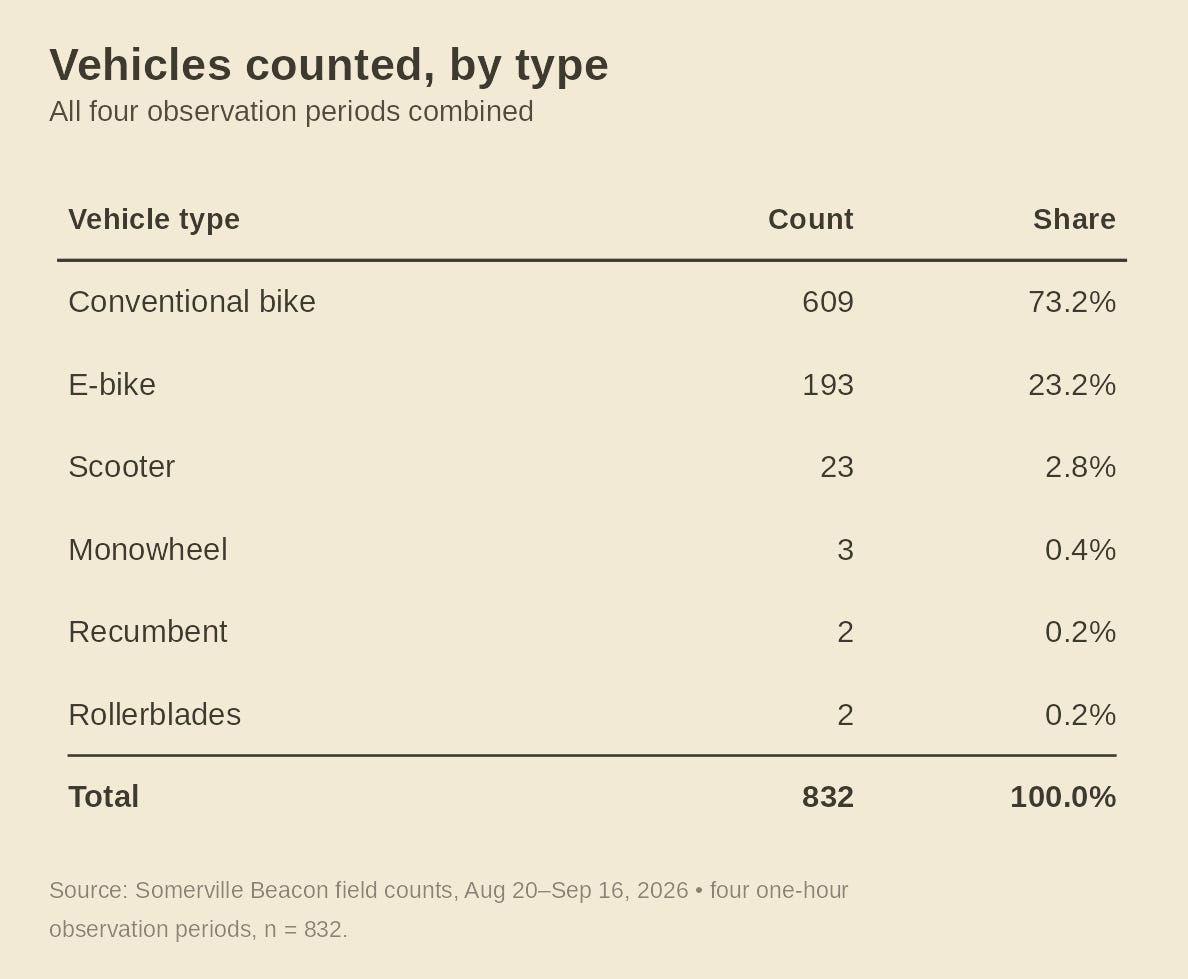
Traditional bicycles were the most common vehicle we saw, at about 73% of vehicles. Next most common were e-bikes at about 23%.2
Next most common were various forms of electric scooters, three monowheels (that’s what we called them at least; models like this), two recumbent bikes, and finally, two people on rollerblades.
Happily, we did not observe a single gas-powered vehicle on the community path, despite anecdotal reports of gas mopeds rocketing down the path in the evenings.
How fast were people going, on average?
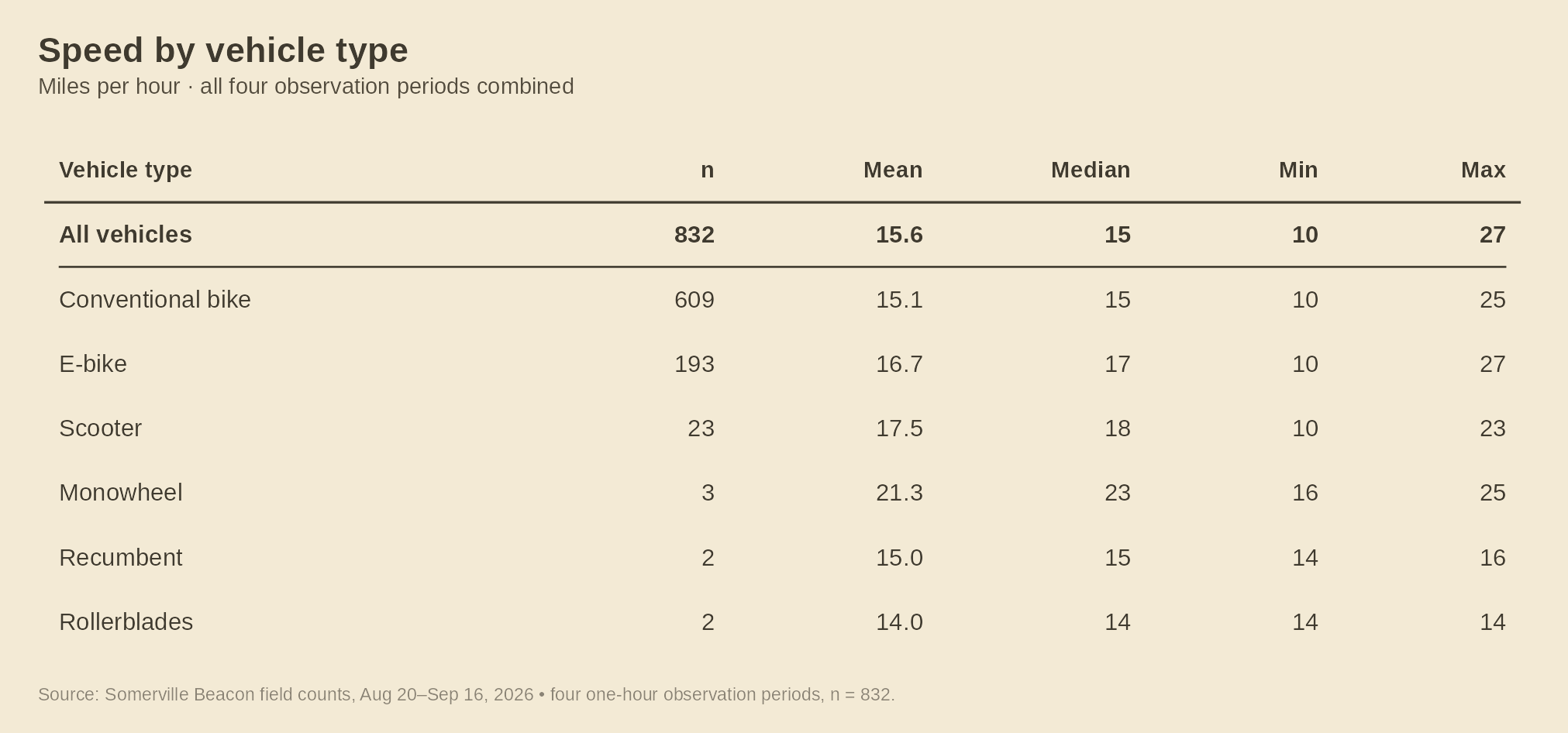
Overall we observed a mean speed of 15.6 mph, a median speed of 15 mph, and a range of 10 mph to 27 mph.3
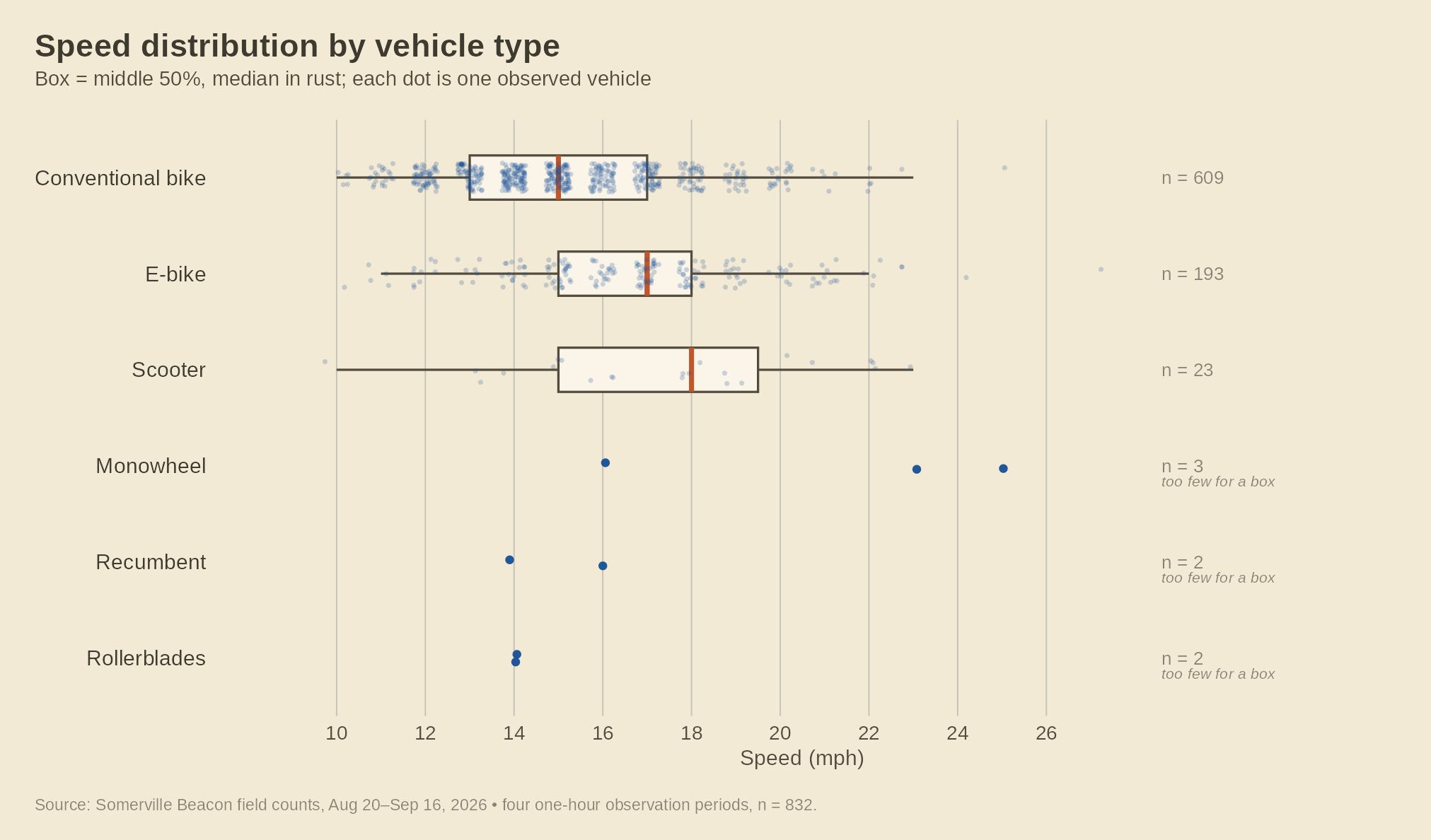
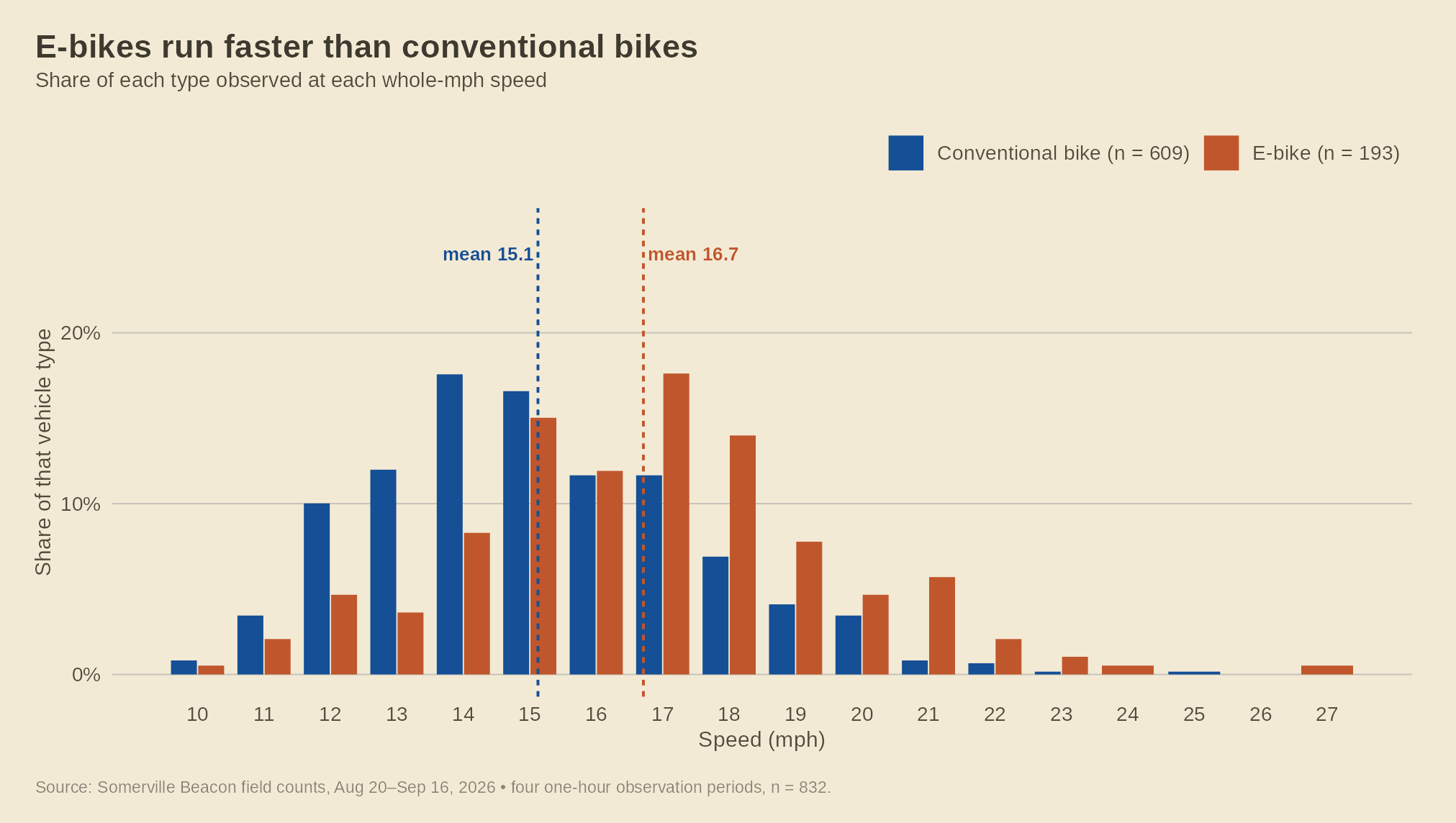
Unsurprisingly, e-bikes tended to be traveling faster than conventional bikes. Perhaps surprisingly: not that much faster! Compared to 15.1 mph for conventional bikes, e-bikes averaged 16.7 mph, a difference of only 1.6 mph [95% CI: 1.2 to 2.0].
What surprised me is that scooters had a higher average speed than e-bikes, at 17.5 mph, and the fastest average speed of any vehicle goes to the monowheels, at 21.3 mph! We had a very small sample size for monowheels (just 3 observations), but even the slowest monowheel we saw was going faster than the average conventional bike.
Sitting by the path, any vehicle going under 20 mph felt pretty safe. I wouldn’t want to get hit by an e-bike going 16 mph, but that speed doesn’t feel reckless. Cyclists at that speed seem in control of their bike, and my intuitive sense was that if there were an actual collision, I would be able to walk away from it.
Everything moving faster than 20 mph felt dangerous. Even a conventional bike felt concerning at these speeds, and we did clock conventional bikes up to 25 mph.4
The fastest vehicles
Let’s take a closer look at our speediest group. We observed 37 vehicles going over 20 mph, 4.4% of measured traffic.
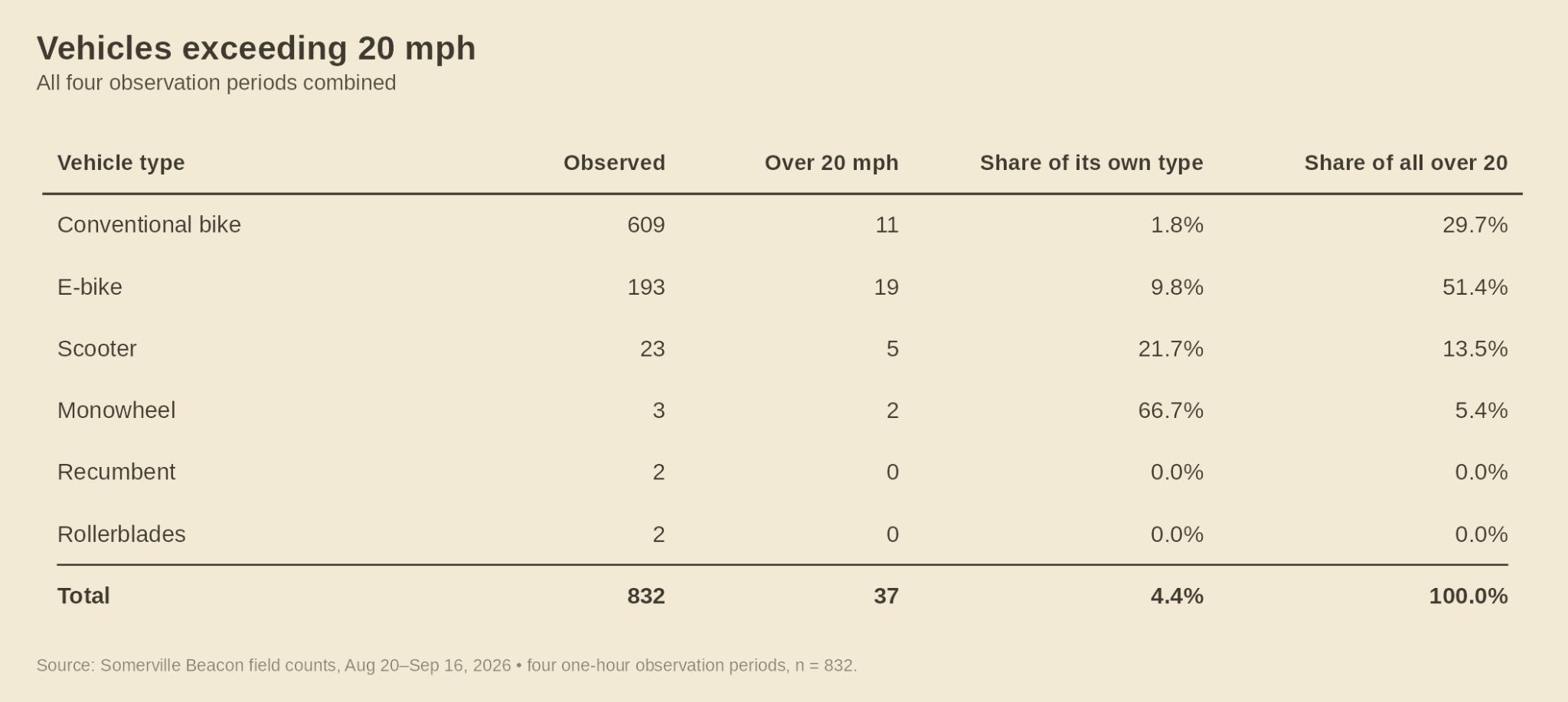
E-bikes were the most common vehicles going > 20 mph, and we observed 19 e-bikes at these speeds. But we also observed 11 conventional bikes going faster than 20 mph.
The real speed demons are people on scooters, making up 13.5% of people going > 20 mph despite being less than 3% of all vehicles — and 21.7% of scooters going at these speeds. And people on monowheels, with 66.7% (2 out of 3) monowheels we observed going > 20 mph.
In short, if you see someone going faster than 20 mph on the community path, our data suggest they’re probably on an e-bike. But this is largely due to base rates. Most e-bike riders stay below 20 mph.
You won’t see many scooters on the community path, but if you do, there’s about a 1 in 5 chance that it’s going faster than 20 mph, and if you see a monowheel, there’s better than even odds it’s going that fast.
Speed Limits
Technically speaking, none of these people were breaking the law, because there’s currently no speed limit on the Community Path.
The city of Somerville can put a speed limit or other restrictions on the path. State Law c. 85 §11B¾ says that:
(c) A municipality, local authority or state agency with jurisdiction over a bike path or bikeway after public notice and a public hearing may adopt ordinances or regulations prohibiting or otherwise regulating the operation of electric bicycles on such paths, including, but not limited to, the imposition of speed limits.
Before publication, we reached out to the Somerville Law Department, who confirmed that there was no current speed limit in effect on the Community Path. They also clarified that any speed limit would not be imposed by ordinance, but by the Traffic Commission, saying: “The Somerville City Charter delegates exclusive authority to the Traffic Commission to make rules and regulations relative to the movement, stopping, standing or parking of vehicles on all streets, ways, highways, roads, and parkways under the control of the city.”
Besides speed, there are existing limits on the type of vehicles that can be used on the path. E-bikes can be used on paths open to conventional bicycles, but “electric bicycle” is defined narrowly in c. 90 §1. Massachusetts recognizes only Class 1 and Class 2. A bike that assists past 20 mph fails both tests, so what the industry calls Class 3 isn’t an “electric bicycle” under Massachusetts law.
The City also confirmed that motorized scooters are not allowed on the path.
Methods
To measure speed, we used the Bushnell Velocity Speed Gun (User Guide and User Manual are linked on that page). We picked a spot on the benches near the exercise equipment (Google Maps labels it as “Calisthenics Park”) just west of Maxwell’s Green. These ones:
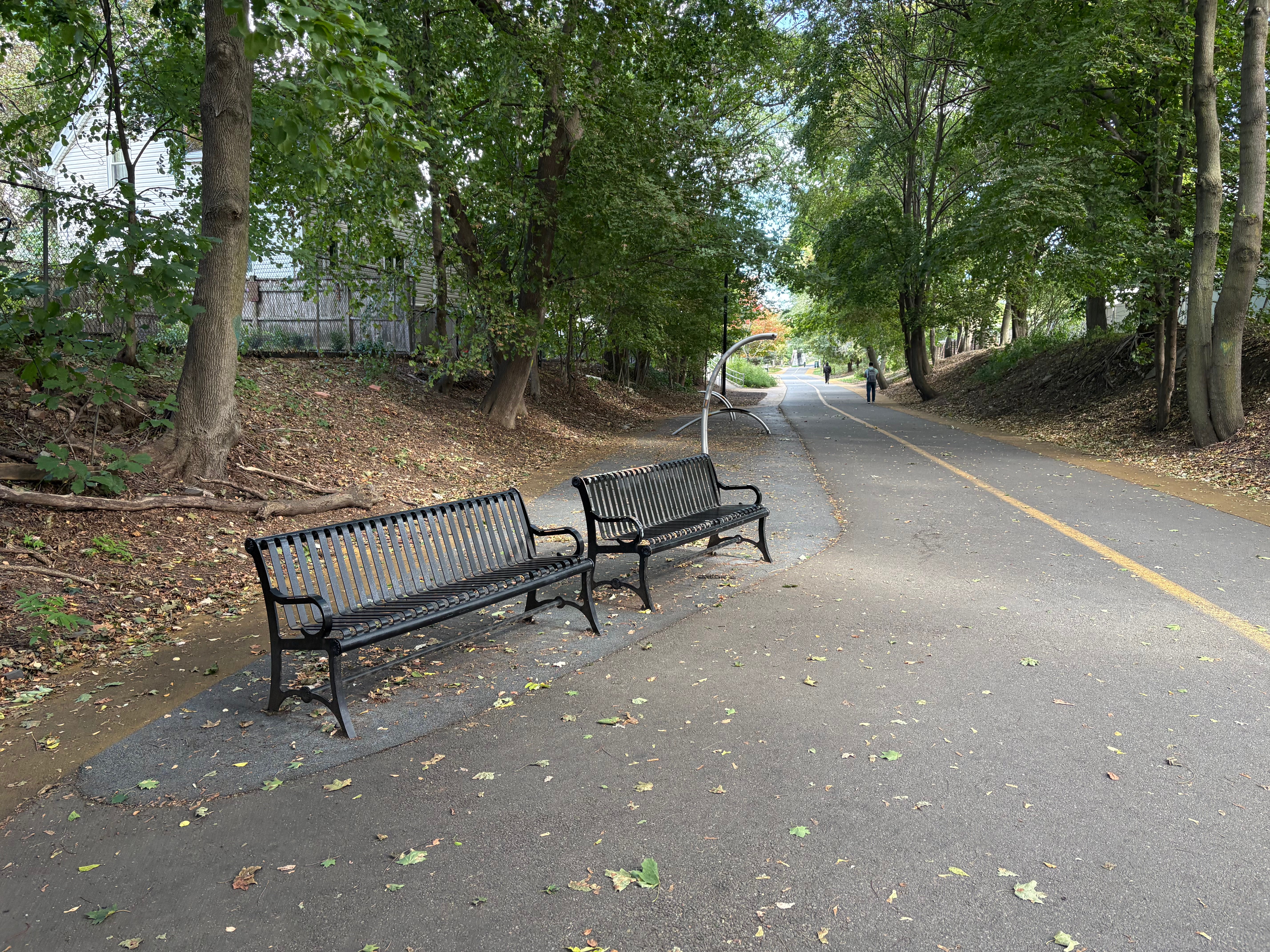
This seemed like a good spot to get a sense of how fast vehicles are going on the trail. It’s in the middle of a long, straight, mostly flat section, so vehicles have plenty of time and distance to get up to their cruising speed without much gravity assist, and we could see them coming from a long way away.
We sat out on the Community Path for four sessions, each an hour long. Two mornings — Thursday, August 20th from 9 to 10 AM, and Tuesday, September 8th from 8 to 9 AM. And two evenings — Wednesday, September 9th from 5 to 6 PM, and Wednesday, September 16th from 6 to 7 PM. We picked these times to give us a sense of the morning and evening commute, when we expected the most vehicle traffic.
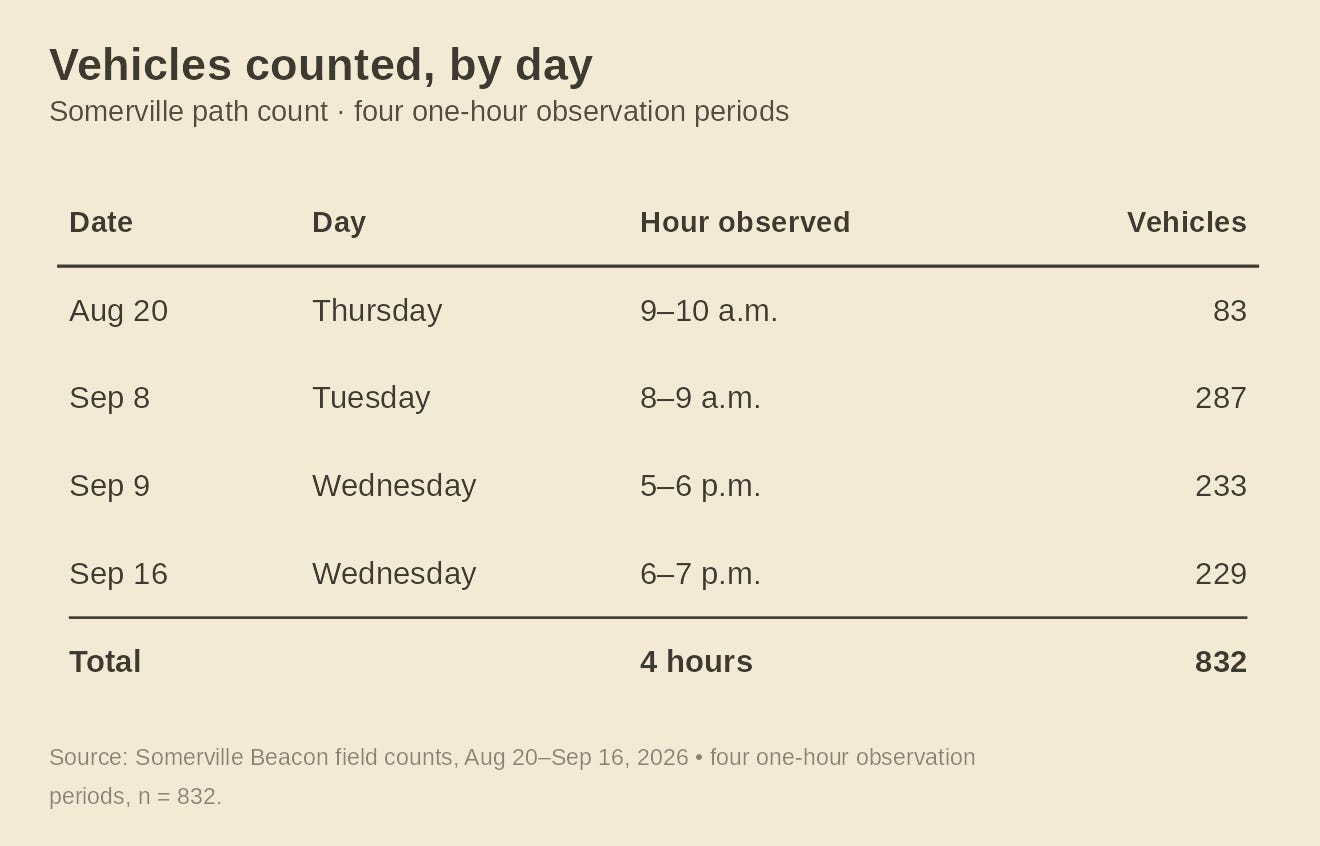
During this time, Ben used the radar gun to measure the speed of every vehicle that passed, and Ethan wrote down the speeds. We considered anything with wheels that fully carried an adult to be a vehicle.
The experience was very pleasant — people on bikes good-naturedly calling out “how fast am I going?”, or pedestrians stopping to thank us for collecting data, citing the dangerous experiences they’d had with high-speed vehicles on the path.
There are some limitations on the data we were able to collect. Speeds are not perfectly accurate because the radar gun is not perfectly accurate. In the 100 meters or so of measuring distance, people didn’t maintain a perfectly constant speed.
We didn’t stop people to ask what vehicle they were riding, and there are an increasingly diverse number of scooter/e-bike hybrid vehicles that defy easy classification, so all vehicle types are our best guesses.
We weren’t able to clock the speed of every vehicle we saw. Sometimes there was too much foot traffic to get a good reading. Sometimes 7 bikes would pass at once and we couldn’t get readings for each one. Sometimes we stopped collecting data for a couple minutes to talk with passers-by. The radar gun does not register speeds below 10 MPH, so vehicles traveling slower than that aren’t in the dataset at all. We don’t claim to have clocked the speed of every vehicle — but we do think the data are mostly accurate.
Anonymized Raw Data

There’s been repeated concerns around some of the vehicles on the path, especially the reckless behavior of some riders, and the vehicles’ speed. There’s even been discussion of a speed limit.
This is probably a slight undercount. We expect we were more likely to mistake an e-bike for a conventional bike than vice versa, so there were probably slightly more e-bikes and fewer conventional bikes than marked.
These averages shouldn’t be seen as true averages, as the radar gun didn’t report speeds below 10 mph; these should be understood as the averages of vehicles we measured going 10 mph or faster.
Subjectively, it was interesting to see that for the most part, it was easy to tell how fast a vehicle was going, and my intuitions usually matched the radar gun — unless the vehicle was loud! Vehicles with fat wheels make a special buzzing sound, and some e-vehicles have louder electric motors than others. Vehicles making these sounds always felt subjectively like they were going much faster than the radar gun would report. So these vehicles are slower than they seem, and are probably even safer on top of that, since it’s easy to hear them coming.
Excellent Analysis! Would be curious to pair this with a back-of-the-envelope estimate of vehicle+rider mass to get a quick-and-dirty read on kinetic energy and corresponding injury risk should a vehicle-pedestrian or vehicle-vehicle collision occur.